
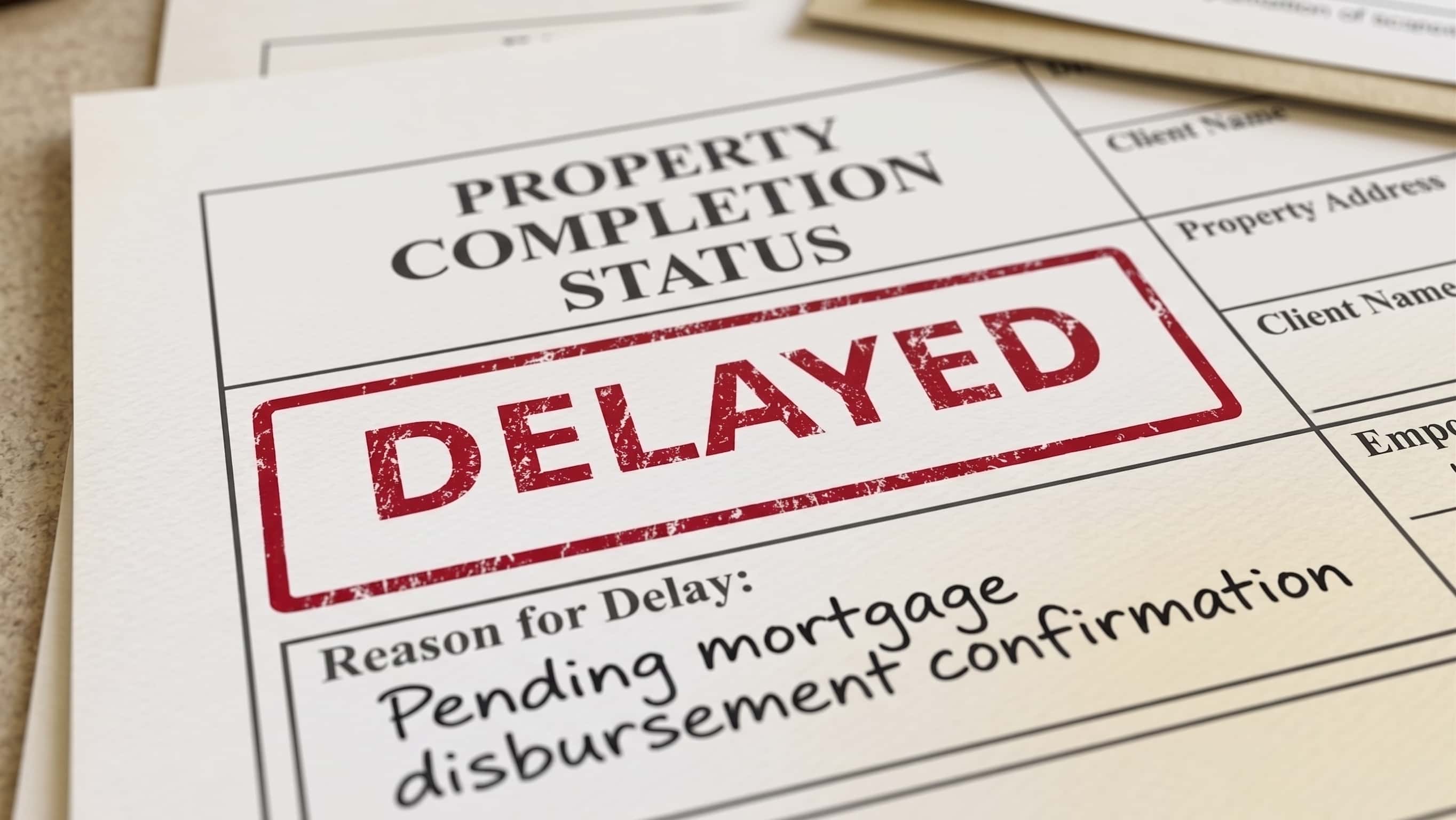
You've applied for a mortgage and exchanged contracts on a UK buy-to-let off-plan property. The completion date is set.
Then, days before you're due to complete, your mortgage lender asks for more time.
For overseas investors, this is one of the most common and costly situations in UK property investment.
This guide explains what delayed completion means, what it costs you, and how you can secure your UK property past the completion date.
What is delayed completion?
Once contracts are exchanged, the completion date becomes legally binding, meaning both you the buyer and seller are committed to completing the transaction on that date.
Completion is the final step in a UK property purchase, where your solicitor transfers the remaining funds to the seller’s solicitor, ownership officially transfers, and you receive the keys.
If funds don't arrive by the agreed time, you are technically in breach of contract, even if the reason is outside your control.
Delayed completion is when the buyer and seller fail to complete on the agreed date. For overseas buy-to-let investors, there are common reasons why completion is delayed.
What are the common causes of delayed completion for non-UK residents?
Several things can prevent funds from arriving on time. The most common across all UK property purchases are:
- Mortgage delays: This is typically the #1 reason for non-UK residents. A lender may need additional checks, updated documents, or a re-valuation before releasing funds. Even a short delay on completion day, with funds arriving after the 2pm cut-off, pushes legal completion to the next working day.
- Slow or unanswered legal queries: Conveyancing involves a chain of steps; such as searches, title checks, contract queries; and a single unanswered question can stall everything until it's resolved.
- Funds sent from an unverified account: Solicitors are legally required to verify the source of all funds. If money arrives from an account not previously checked, or via a method such as the Bankers' Automated Clearing Services (BACS) that takes days to clear, the solicitor cannot draw on it until it is verified and cleared.
- International bank transfers take longer: Funds passing through multiple banks or currency controls can take several days to arrive and clear, long enough to miss a completion deadline.
Tip: If your mortgage approval is running close to your completion date, ask your broker for a written revised timeline. If it's within 10 days of completion, start planning your backup now, not after the date has passed.
What are the risks of a delayed completion?
The consequences escalate quickly the longer the delay runs, such as:
- Penalty interest from day one: Under Standard Condition 7.2 of the Standard Conditions of Sale, the party causing the delay pays interest at the contract rate - typically 4% above the Bank of England base rate - for every calendar day of delay. At the current base rate of 4.5%, that means roughly 8.5% annually. On a £300,000 property, that's approximately £70 per day.
- Notice to complete: If you miss the completion date, the seller can serve a formal notice to complete, giving you 10 working days to transfer funds. Once served, that deadline is absolute.
- Deposit forfeiture: If you fail to complete within that 10-day window, the seller can rescind the contract and keep your deposit (usually 20%). On a £300,000 property, that's typically £60,000 gone.
- Loss of the property: Once the contract is rescinded, the seller can relist and sell to another buyer. You also lose the legal and valuation fees already paid.
We've seen buyers lose deposits they'd been building for years because a mortgage decision arrived too late.
Step-by-step: what to do if completion is delayed?
If your mortgage isn't going to be ready in time, act early. The sooner you move, the more options you have.
- Get a realistic timeline from your lender: Ask your lender or broker for a written estimate of when the mortgage offer will be issued. If the issue date is within 10 days of your completion date, you have a problem.
- Notify your solicitor immediately: Your solicitor needs to know as soon as possible. They can open a dialogue with the seller's solicitor and, in some cases, negotiate a short extension to the completion date. However, note that sellers don't tend to extend the completion deadline.
- Ask for a completion date extension: Sellers can agree to defer completion, but they are not obliged to, and again, usually the chances of an extension are low. If the seller is cooperative, your solicitor may be able to agree on a revised date. Expect the seller to ask for compensation or impose conditions.
- Assess whether you need a bridging loan: If the seller won't extend, or if the extension period is too short for your mortgage to clear, a bridging loan is the fastest way to keep the property deal alive.
Note: Don't wait until the completion date has passed to act. By then, the seller is already entitled to serve a notice to complete, and your window to respond shrinks to 10 working days.
How to reduce the risk of delayed completion?
Once contracts are exchanged, you are legally committed to complete on the agreed date.
If funds are not ready in time, you could face penalty interest, lose your deposit, or even risk the transaction collapsing.
Experienced overseas buyers focus on reducing completion risk before exchange happens. Here’s how they typically do it:
- Get your documents ready before making an offer. Gather certified ID, 6 months of bank statements, proof of income, and source of funds documentation before approaching a lender. For overseas buyers, the document stage is where most delays start.
- Work with a mortgage broker who specialises in overseas applicants. A general broker may not know which lenders accept non-residents, or what documentation they require. This costs you time on applications that were never going to be approved.
- Run your mortgage application in parallel with the legal process. Don't wait for an offer to be accepted before starting your mortgage application. Begin as early as possible so that underwriting is well advanced by the time you exchange.
- Most effective: Start applying for bridging finance as a backup before the completion date. Confirm that a bridging lender will fund your purchase if your mortgage is delayed; and confirm the exit route, security, and worst-case cost if the refinance takes longer than planned.
Get a bridging loan with GoGoProp to secure your property before a completion deadline
A well-prepared property investor doesn't leave completion to chance.
One couple based in Ghana had done everything right. They'd exchanged contracts, paid their deposit, and were days from completion.
Suddenly, their lender requested additional overseas underwriting checks, and their completion date wasn't moving. Without a bridging loan, they would have lost their deposit and the property. Instead, they secured a bridging loan within 24 hours and completed in 13 days.
GoGoProp offers short-term bridging loans built specifically for overseas buy-to-let investors:
- Initial approval in 24 hours.
- Funding in as little as 10 days.
- Interest is fixed at 1% per month, with a 2% handling fee and no hidden charges.
- Loan terms run from 3 to 12 months, with no early repayment penalties.
Contact the GoGoProp team to secure your property before your completion deadline.
Key takeaways
- Delayed completion occurs when a buyer fails to transfer funds on the agreed date. For overseas investors, the cause is almost always a mortgage that isn't ready in time.
- Penalty interest accrues from day one at roughly 4% above the Bank of England base rate. On a £300,000 property at current rates, that's around £70 per day.
- The seller can serve a notice to complete after the completion date passes. If you still can't complete within the ten working days specified, they can cancel the contract and keep your deposit.
- The most effective protection is arranging bridging finance before you exchange contracts, so a mortgage delay never puts your deposit at risk.
- Act as early as possible, ideally before exchange, at the latest several weeks before the completion date if you suspect any delay.
- Once the completion date has passed, your options narrow quickly and costs rise.
Frequently asked questions
What happens if I can't complete on the agreed date?
You're in breach from day one. Penalty interest accrues and the seller can cancel the contract and keep your deposit.
Can I lose my deposit if completion is delayed?
Yes, miss the ten-day notice window and the seller can rescind, which is20% of the purchase price gone.
Can the seller agree to extend the completion date?
Yes, but they are not obliged to, and the chances of a seller extending the completion date are small. An extension must be agreed by both parties and is usually formalised by the solicitors. Sellers may also use the delay as leverage to renegotiate terms or extract compensation.
How long between exchange and completion should non-UK residents budget for?
As a practical rule, non-UK residents should build in 10-12 weeks between exchange and completion. This covers overseas underwriting, document checks, and unexpected lender requests.
How is a bridging loan different from waiting for my mortgage?
A bridging loan funds your purchase immediately. You repay it once your mortgage is approved, typically within 10 days.


%20(1).jpg)
